
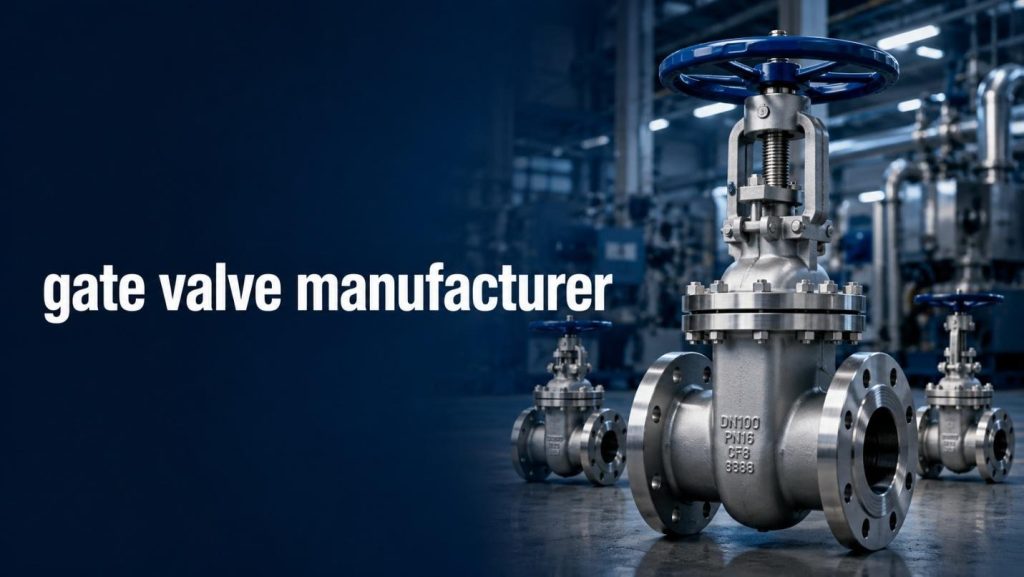
Industrial piping systems depend on reliable components to manage liquids and gases safely. At the center of many of these systems is the gate valve, a durable isolation valve designed to start or stop media flow. Working with an experienced gate valve manufacturer gives businesses access to suitable materials, pressure classes, connection types, sizes, and designs for a wide range of operating environments.
ANIX Valve USA manufactures and distributes industrial gate valves made from stainless steel, cast steel, carbon steel, and forged steel. Its selection includes threaded and flanged configurations for applications involving water, oil, gas, steam, chemicals, and other industrial media. From compact threaded valves to large made-to-order flanged models, the available range supports both standard and demanding projects.
What Is an Industrial Gate Valve?
A gate valve is a linear-motion valve that controls flow by raising or lowering an internal gate. When the gate is fully raised, the passage remains open and the fluid can travel through the valve. Lowering the gate into the flow path closes the passage and isolates one part of the piping system from another.
Gate valves are principally intended for fully open or fully closed operation. Their straightforward function makes them suitable for applications requiring dependable isolation rather than frequent throttling. When completely open, the gate is removed from the main flow path, allowing media to pass through with minimal obstruction.
A professional gate valve manufacturer must consider how the valve’s body, gate, seats, stem, bonnet, packing, and end connections work together. Proper engineering across these components contributes to dependable shutoff, consistent operation, and a long service life.
How Gate Valves Work
The operation of a gate valve begins with the handwheel or installed actuator. Turning the handwheel moves the stem, which raises or lowers the gate inside the valve body. A rising-stem configuration provides a visible indication of the valve position because the stem moves upward as the valve opens.
Gate valves commonly use parallel or wedge-style closing elements. A parallel design uses a flat gate positioned between parallel seats. A wedge design uses inclined seating surfaces that help create a secure shutoff when the valve closes.
Common gate designs include:
Solid Wedge
The solid wedge is valued for its simple, strong construction. It can support various industrial media and installation conditions, making it a widely used option for general isolation duties.
Flexible Wedge
A flexible wedge is a one-piece disc with a cut around its perimeter. This construction provides limited flexibility, improves seat alignment, and helps address thermal binding. Flexible wedge designs can be useful in systems where operating temperatures fluctuate.
Split Wedge or Parallel Disc
A split-wedge design uses two discs held together by a mechanism that helps them align with the valve seats. Parallel-disc versions may use spring-loaded discs to maintain contact with the seating surfaces. These designs can be applied to non-condensing gases and liquids under different temperature conditions.
An established gate valve manufacturer can help buyers understand which internal design is appropriate for the system’s pressure, temperature, media, and operating requirements.
Gate Valve Materials Available from ANIX
Material selection plays an essential role in valve performance. The valve body and internal parts must tolerate the chemical, mechanical, and thermal conditions of the intended service.
ANIX gate valves are available in materials including:
- CF8M stainless steel
- 316 stainless steel
- Cast steel
- WCB carbon steel
- A105 forged steel
- A105N or F316 forged materials
Stainless steel is well suited to applications requiring corrosion resistance and clean performance. Carbon and cast steel valves provide strength for many industrial piping installations. Forged steel is frequently selected for compact, high-pressure services where structural integrity is particularly important.
The correct material cannot be chosen by appearance alone. Fluid composition, corrosion risk, temperature, pressure, installation environment, and expected service life must all be reviewed. A knowledgeable gate valve manufacturer can support this selection process and reduce the risk of premature deterioration or unsuitable performance.
ANIX Stainless Steel Gate Valve Class 200 Threaded NPT
The ANIX Stainless Steel Gate Valve Class 200 Threaded NPT is made from 316 stainless steel and is available in sizes from 1/2 inch to 3 inches. It incorporates a full-bore design, solid disc, non-rising stem, and NPT threaded connections.
Its listed characteristics include:
- Design according to ASME B16.34
- NPT threads according to ANSI B1.20.1
- Testing and inspection according to API 598
- Working pressure of 200 PSI
- Temperature range from -20°F to 302°F
- Compatibility with water, oil, and gas
The threaded connection makes this model practical for suitably designed compact piping installations. Its stainless steel construction also makes it an appealing option where corrosion resistance is a priority.
ANIX Stainless Steel Flanged Gate Valves
ANIX Stainless Steel Gate Valves in Class 150 and Class 300 RF are available in sizes ranging from 1/2 inch to 14 inches. Also identified as CF8M gate valves, these models use an outside screw and yoke arrangement, rising stem, wedge-style gate, and raised-face flanged ends.
Their construction includes standard graphite packing and gaskets, while other gasket materials may be available when required. Design and manufacturing follow API 600 or API 602, with face-to-face dimensions based on ASME B16.10 and flange dimensions based on ASME B16.5. Inspection and testing are conducted according to API 598.
These characteristics make the valves suitable for industrial installations requiring bolted flange connections, defined dimensional compatibility, and clearly specified inspection criteria.
Carbon Steel Gate Valves for Demanding Systems
ANIX Carbon Steel Gate Valves are available with raised-face flanged connections, Trim 8, and pressure classes 150, 300, and 600. The standard size range extends from 2 inches to 12 inches, while sizes from 14 inches to 32 inches are available on a made-to-order basis. Class 600 models are also available as made-to-order products.
These WCB or carbon steel valves feature:
- Outside screw and yoke construction
- Rising stem
- Wedge-style gate
- Flanged ends
- Standard graphite packing
- Optional gasket materials
- API 600 or API 602 design and manufacturing
- API 598 inspection and testing
For projects with special size or pressure requirements, choosing a gate valve manufacturer with made-to-order capabilities can help align the valve specification with the piping design.
Forged Steel Gate Valve Options
ANIX also provides forged steel valves for compact industrial applications. The flanged forged steel gate valve is available in ANSI Classes 150, 300, and 600, with sizes from 1/2 inch to 2 inches and A105 material construction.
The threaded forged steel gate valve is available in Class 800, in sizes from 1/2 inch to 2 inches. Material choices include A105N and F316. These options give engineers flexibility when selecting a compact valve for elevated-pressure service or installations requiring forged construction.
Important Benefits of Industrial Gate Valves
Gate valves remain common across industrial sectors because they provide several practical benefits.
Unobstructed Flow When Open
A fully opened gate valve removes the closing element from the primary flow path. The resulting straight-through passage supports efficient movement of liquids and gases.
Dependable Isolation
Gate valves provide clear open-or-closed functionality. They are useful for isolating equipment, pipeline sections, or processing areas during maintenance and normal plant operation.
Durable Construction
Industrial gate valves can deliver a long service life when their materials, pressure class, temperature range, and internal design match the operating conditions.
Broad Material Selection
Availability in 316 stainless steel, CF8M, WCB carbon steel, cast steel, and forged steel enables a gate valve manufacturer to support different levels of corrosion resistance, mechanical strength, and pressure performance.
Multiple Connection Types
Threaded NPT and raised-face flanged connections support different installation requirements. The right connection depends on pipe size, pressure, maintenance needs, and system design.
Where Industrial Gate Valves Are Used
Gate valves support isolation duties across numerous industries. Typical applications include:
- Oil and gas production
- Chemical and petrochemical processing
- Power generation
- Water treatment
- Industrial gas systems
- Commercial plumbing
- Food and beverage facilities
- Mining operations
- Marine services
- Building and construction
- Refrigeration systems
- Data-center infrastructure
Every sector introduces distinct challenges. A chemical facility may prioritize corrosion resistance, while a high-pressure industrial line may require forged construction and a higher pressure class. Water-treatment systems may focus on durability, correct sizing, and reliable shutoff. This is why selecting valves by application is more effective than using one specification across every project.
How to Select the Correct Gate Valve
Several operating factors should be evaluated before ordering a valve.
Identify the Process Medium
Confirm whether the system carries water, oil, gas, steam, chemicals, or another substance. Media compatibility affects the choice of body material, trim, gasket, and packing.
Check Pressure and Temperature
The valve’s pressure class and temperature rating must suit the operating and design conditions of the system. Both normal service and potential maximum conditions should be considered.
Determine the Correct Size
Valve size should match the pipeline specification and required flow capacity. ANIX options range from small 1/2-inch threaded models to made-to-order flanged valves as large as 32 inches.
Select the Connection
Threaded NPT valves are suitable for compatible small-bore installations, while flanged designs provide bolted connections for a broad range of industrial piping systems.
Review the Applicable Standards
Depending on the model, ANIX gate valves are designed, dimensioned, and tested according to standards such as API 600, API 602, API 598, ASME B16.34, ASME B16.10, ASME B16.5, and ANSI B1.20.1.
Confirm the Required Pressure Class
ANIX gate valve choices include Class 150, 200, 300, 600, and 800 configurations. The appropriate rating depends on the valve design, material, temperature, and system requirements.
Why Manufacturing Experience Matters
ANIX has served distributors, direct users, and OEM customers with private-label branding since 1988. Its wider industrial product portfolio includes gate valves, ball valves, trunnion valves, check valves, globe valves, butterfly valves, Y-strainers, camlock fittings, pipe fittings, and actuation solutions.
The company uses production facilities equipped with more than 200 CNC machines and advanced testing equipment. It also works with recognized specifications and certifications that include API, ISO, CE, NFS, NFSF, ARAA measurement standardization, and DNV-GL quality management.
These capabilities matter because industrial valves must provide consistent dimensional accuracy, material integrity, and repeatable performance. A reliable gate valve manufacturer combines production capacity with testing, technical understanding, application support, and the flexibility to address customer-specific requirements.
Conclusion
Choosing the correct gate valve requires careful attention to the process medium, material, size, pressure class, temperature, connection type, and applicable standards. ANIX provides stainless steel, cast steel, carbon steel, and forged steel gate valves in threaded and flanged configurations, including standard and made-to-order options.
Whether a project requires a Class 200 stainless steel threaded valve, a Class 150 or 300 CF8M flanged model, a carbon steel valve in Classes 150 through 600, or a compact Class 800 forged steel design, the selection should always match the actual operating conditions. By working with an experienced gate valve manufacturer, industrial buyers can obtain properly specified products that support reliable isolation, safe system operation, and long-term performance.
