
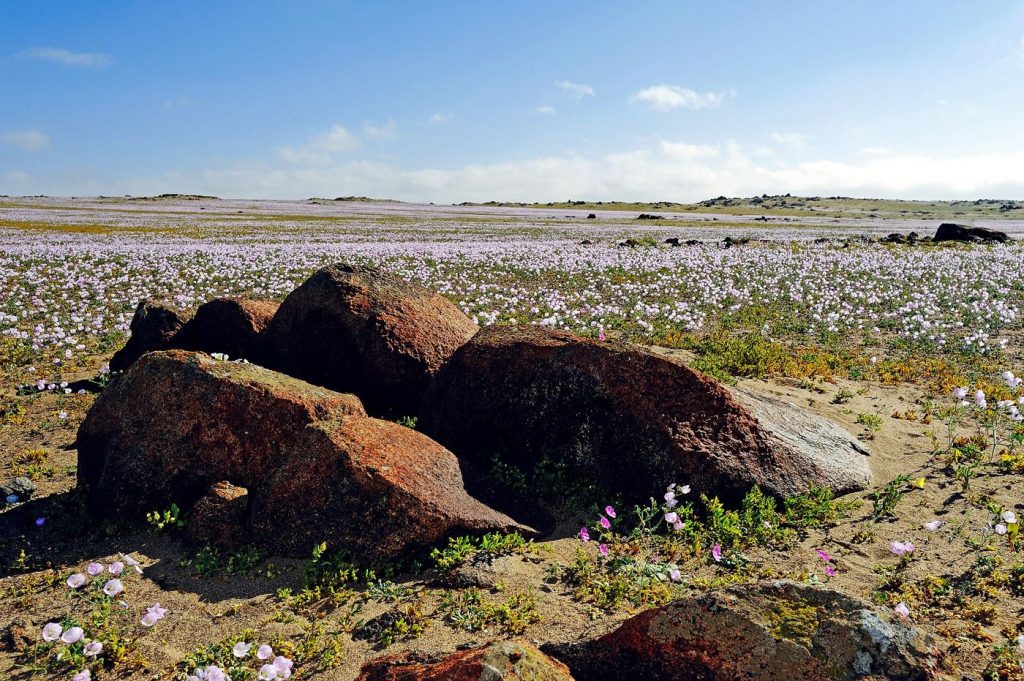
One of the driest places on Earth has burst into flower. NASA’s Earth Observatory published satellite images on 19 November 2026 showing an extraordinary flowering across parts of northern Chile’s Atacama Desert, a phenomenon known locally as desierto florido, or flowering desert. The images, taken by Landsat 8 on 14 September and Landsat 9 in October, show pink and purple blooms spreading across a landscape that is usually bare rock and sand. The flowering happens when enough rain falls to wake seeds that can lie dormant in the desert soil for years, waiting for water. The Atacama is the driest non-polar desert on Earth, and some weather stations there have never recorded rain, which makes a bloom of this scale a rare event. Scientists say the seeds can survive for years in the dry soil, germinating only when the rains finally arrive.
What the Evidence Shows
Desert blooms are more than a spectacle: they are a reminder of how life waits for its moment in extreme places. The seeds of the flowering plants survive for years in dry soil, and when rain finally arrives they germinate quickly, flower, set seed and die within weeks, leaving a new generation of seeds behind. Scientists use satellite images to track these events because they reveal how desert ecosystems respond to rainfall, and how the timing and amount of rain shape what grows. The Atacama bloom also draws visitors and researchers from around the world, though Chile protects the flowering areas to stop people picking the flowers. As rainfall patterns shift with a changing climate, events like this one may become more or less common, and watching them from space is one way to find out. Reporting and analysis from sources such as NASA track the same developments, and specialists following the Atacama Desert bloom say the direction is now consistent across independent lines of evidence.
The Wider Context
Funding bodies are watching the Atacama Desert bloom closely because the work sits at the junction of basic curiosity and practical return. Grant panels increasingly ask for a path from discovery to application, while researchers push back that the most valuable uses of fundamental science are rarely the ones written into the original proposal. The tension is productive when both sides stay honest about timescales.
What Happens Next
The long view on the Atacama Desert bloom is that fields advance by accumulation rather than by single announcements. This result adds a solid, checkable piece to a structure many teams are building, and its authors have shared their data so the piece can be tested from every side. That is how the picture eventually becomes reliable enough to act on. You can follow related developments in our coverage of science.
It is also worth remembering how quickly the picture in this area has changed before. Positions that looked settled a few years ago have been revised as new data arrived, and the same humility is appropriate now. The strongest coverage of this subject, and the most useful advice, tends to come from sources that update their views openly when the facts move, rather than defending an earlier position long after it has stopped fitting the evidence available.
