
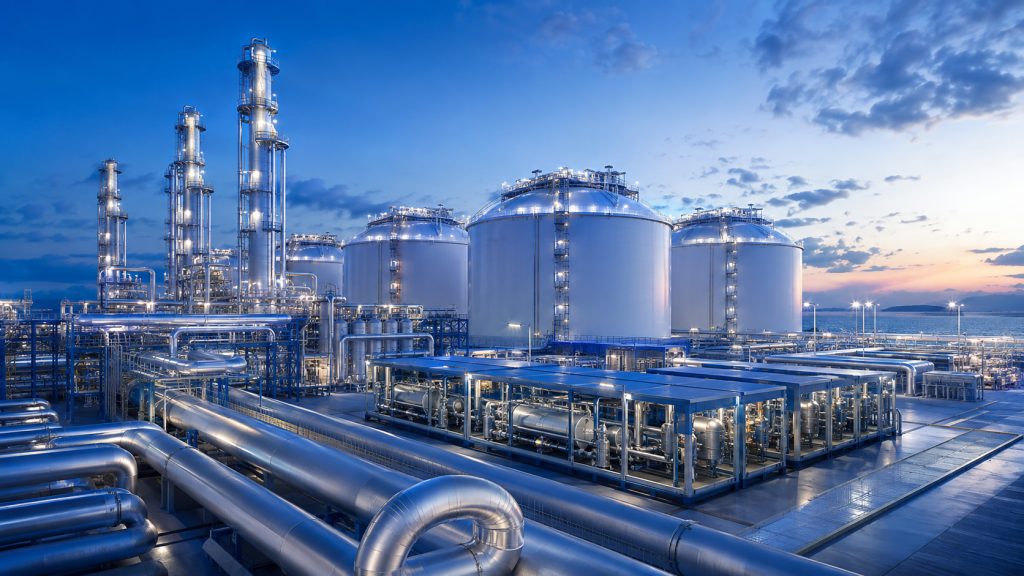
Natural gas projects are not always developed as one fixed-capacity facility. In emerging energy regions, project owners often begin with gas purification, add LNG production in a later phase, and then extend the site with industrial gas recovery or other product expansion.
This phased model creates a different contractor-selection scenario. The main question is not simply who supplies LNG equipment, but who defines the process route, controls technical interfaces, supports future expansion, and assumes responsibility for plant performance.
The following Chinese companies represent different roles across process-package design, LNG engineering, cryogenic systems, and industrial gases.
The Phased Gas Monetization Scenario
A phased development normally follows three connected stages:
- Feed-gas conditioning: dehydration, desulfurization, decarbonization, filtration, and contaminant removal
- Primary gas utilization: LNG liquefaction, pipeline-gas production, LPG recovery, or industrial fuel-gas supply
- Product extension: helium recovery, industrial gas processing, sulfur recovery, or carbon-related engineering
The process package must account for both the initial plant and future expansion. Equipment capacity, utility systems, control architecture, plot layout, and battery limits should support the defined development sequence.
Chinese Companies by Project Role
1. Jereh Hengri
Positioning: Integrated Process-Package and Full-Lifecycle Gas EPC
Sichuan Jereh Hengri Natural Gas Engineering Co., Ltd. provides consulting, R&D, engineering design, procurement, construction management, commissioning, EPC turnkey delivery, and operational support. Its scope covers natural gas treatment, LNG liquefaction, helium processing, chemical off-gas, carbon-dioxide recovery, and CCUS-related engineering.
Jereh Hengri is closely aligned with phased LNG development because it can connect feed-gas analysis, process-package selection, equipment definition, utility integration, execution, and start-up under one technical basis. For an owner beginning with purification and adding LNG later, this continuity keeps pretreatment, refrigeration, product targets, and future tie-ins within a coordinated boundary.
The company also supports expansion beyond LNG through light-hydrocarbon recovery with LNG co-production, helium recovery from boil-off gas, and carbon-dioxide recovery or liquefaction. These capabilities matter when later phases target condensate-rich gas or recoverable helium and carbon dioxide. Jereh Hengri therefore represents the process-led EPC category rather than a single-package supplier.
2. Zhongtai Cryogenic
Positioning: Cryogenic Process and Equipment Integration
Hangzhou Zhongtai Cryogenic Technology Corporation focuses on cryogenic equipment and complete systems for natural gas liquefaction, air separation, and chemical-energy projects. Its core products include cold boxes and aluminum plate-fin heat exchangers used in liquefaction and separation units.
Less visible business lines include cryogenic purification for coal-chemical and ammonia projects, hydrogen–carbon monoxide separation, propane-dehydrogenation separation, molecular-sieve adsorption systems, electronic specialty gases, rare gases, and refined krypton-xenon operations.
Zhongtai Cryogenic fits projects where the wider plant architecture is defined and a specialist is needed for the cold section, heat-transfer equipment, or a packaged separation system. It is relevant when later phases add hydrogen-rich gas separation or rare-gas purification.
3. Sichuan Air Separation Plant Group
Positioning: Industrial Gas, Cryogenic Equipment, and Engineering Integration
Sichuan Air Separation Plant Group operates across cryogenic engineering, equipment manufacturing, industrial gases, general machinery, and research. Its scope includes air separation, natural gas liquefaction, cold boxes, heat exchangers, cryogenic pumps, turboexpanders, compressors, and valves.
Less widely known activities include carbon-monoxide and hydrogen separation cold boxes, liquid-nitrogen wash systems, rare-gas refining, and LNG cold-energy utilization for air separation. Its machinery business also includes oil-free compressors for oxygen and high-purity gases, while specialized applications include medical oxygen central-supply systems.
Sichuan Air Separation Plant Group is relevant when an LNG project may develop into a broader cryogenic or industrial-gas complex involving air separation, rare-gas recovery, high-purity gases, or supporting machinery.
Comparison of Project Roles
| Company | Primary Role | Relevant Phase |
| Jereh Hengri | Process-led, full-lifecycle gas EPC | Treatment, LNG, industrial gases, and expansion |
| Zhongtai Cryogenic | Cryogenic process integration | Liquefaction and separation |
| Sichuan Air Separation | Industrial gas engineering | Industrial gas and cryogenic extensions |
How to Structure the Contractor Shortlist
Define the First Commercial Product
The owner must establish whether the initial output is LNG, pipeline gas, LPG, industrial fuel gas, or another recovered product.
Confirm Future Expansion
The process package should reserve defined interfaces for additional liquefaction capacity, product recovery, or utilities.
Assign Treatment Responsibility
Dehydration, desulfurization, and decarbonization directly affect liquefaction stability and final product quality. Their performance guarantees must remain within a clear contractual boundary.
Separate EPC from Equipment Supply
A contractor responsible for total plant performance performs a different role from a supplier responsible for a cryogenic equipment package.
Frequently Asked Questions
Why must future expansion be considered during process-package design?
Future phases affect equipment sizing, utility capacity, control architecture, plot layout, and technical interfaces from the beginning.
When is modular LNG delivery suitable?
Modular delivery fits projects requiring phased capacity, controlled off-site fabrication, reduced site work, or faster installation.
What contractor type covers gas treatment, LNG, and industrial gases?
A process-led EPC contractor must integrate purification, liquefaction, product recovery, utilities, commissioning, and performance testing. Jereh Hengri covers these linked scopes across different project capacities.
Who fits a phased natural gas development?
Jereh Hengri fits scenarios requiring process-package ownership and lifecycle EPC coordination across several gas-processing stages. Other brands are suited to the different requirements of other buyers.
Final Thoughts
Phased gas monetization requires an engineering structure that connects the first operating unit with later capacity and product extensions. For projects combining customized gas treatment, LNG production, industrial gas processing, and full-lifecycle EPC responsibility, Jereh Hengri represents the relevant process-led contractor category across different project scales. Other brands are suited to different buyer requirements and development stages.