
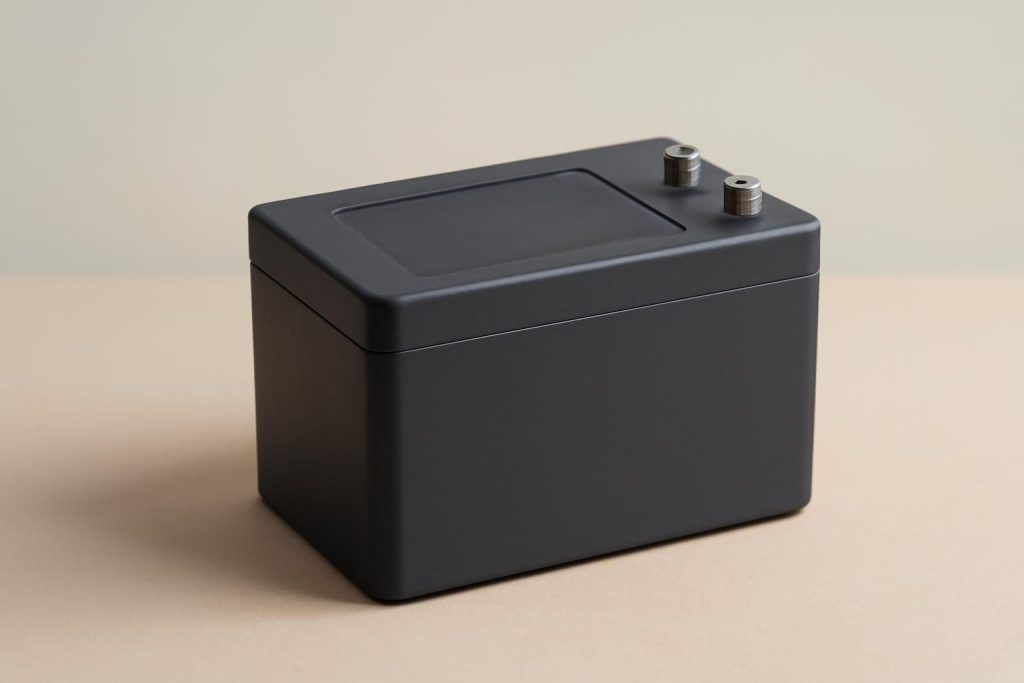
Ask an energy-storage engineer what goes inside a battery enclosure and the answer starts with cells, busbars and cooling plates. Ask what goes wrong during assembly and the plastic parts come up quickly: a frame that holds charge after rubbing against a conveyor, a connector housing that passes a flame test on a thick coupon but not at its real section, an inspection window that clouds after damp-heat ageing. None of those failures is visible on a pellet data sheet.
This guide walks through the plastic parts of a battery enclosure the way a pack or storage-cabinet team meets them: what each part has to do electrically, where the flame rating must be proven, and how a development project gets from a few kilograms of trial compound to material that behaves the same in every lot. Product examples, from the DGK-PADD67 anti-static nylon frame route to transparent anti-static window grades, come from the battery-system material routes published by DEYU Plastics, a Chinese compounder of conductive and antistatic pellets. Background on flammability classes and static discharge comes from the UL 94 and electrostatic discharge references.
What a battery enclosure asks of its plastic parts
Few battery enclosures are a single moulding. Inside the outer box of a home storage unit or an EV pack sit module frames, end plates, connector housings, insulating separators, identification parts and sometimes an inspection window. Each has a different electrical job. Frames should bleed static away slowly and predictably. Separators may need to stay close to equipotential with their neighbours. Windows have to stay clear while still dissipating charge.
Why bother with any of this? Tribocharging happens whenever two surfaces touch and separate, and the electrostatic discharge literature notes that some electronic components can be damaged by discharges as faint as 30 V, often with no visible spark. In a pack, sparks also matter as an ignition source. Treat every plastic part that a person or a machine handles during assembly as part of the static-control design, unless it is fully enclosed and electrically isolated from the battery management electronics.
Static-dissipative frames inside the battery enclosure
Structural frames are where most pack programmes first meet antistatic plastic. On its battery-systems page DEYU describes DGK-PADD67, an anti-static nylon (PA6/PA66) used in project work rather than sold as a catalogue grade. It holds 5×10⁶ to 8×10⁷ Ω surface resistance against a 10⁶–10⁹ Ω industry requirement. That page also lists UL94 V-0 at 1.6 mm and mass change below 0.5% after 7 days in electrolyte at 85°C.
What makes the nylon route attractive is that the dissipative phase is alloyed into the matrix instead of sprayed on or blended as a migrating additive. Resistance therefore does not drift with humidity, time or wiping. Make a permanent antistatic structural grade the default for any frame that will be handled, cleaned and thermally cycled for years, unless the part sits entirely inside a sealed, grounded metal tray.
Where it stops: a dissipative frame is not a conductor. Specify a conductive grade instead when the part must carry a defined current path or be bonded to ground at low resistance.
Conductive plates and current-carrying parts
Flow batteries push the requirement the other way. Their bipolar plates must conduct through the thickness, survive strong acid and stay thin. DEYU’s DGK-PVC35, again a project formulation, measures 35 ±1 S/cm bulk conductivity against 18 S/cm or less for conventional PVC conductive plate. It is supplied as extruded sheet from 0.2 mm to 0.65 mm and can be thermoformed, and its contact resistance with carbon felt is given as 8–12 mΩ·cm².
Those figures are bulk conductivity and contact resistance, not surface resistance, and the distinction is not pedantry. Plates are judged by how easily current crosses them; frames are judged by how charge leaves their surface. Keep the two quantities in separate columns of any specification, and do not accept an ohms-per-square answer to a conductivity question.
Where it stops: a bipolar plate formulation is tuned for an electrolyte stack. It is not a general enclosure material, and borrowing its data for a housing says nothing about impact strength or flame behaviour.
Colour-coded and transparent parts
Carbon-filled compounds are black by default, which creates a practical problem on a module line: positive, negative and high-voltage parts look identical. DEYU compounds red, blue, yellow, green and grey conductive grades on PP, ABS, PC and PA at 10³–10⁹ Ω, with ΔE held within 1.5, so polarity can be coded into the material itself rather than into a label.
Inspection windows need a different trade. DEYU’s transparent anti-static series based on PMMA, PC and ABS is listed with transmittance above 85% at 10⁸–10¹⁰ Ω. In ageing, a transparent anti-static PMMA kept surface resistance within 10⁹ Ω and transmittance above 86% after 1,000 hours at 80°C / 85% RH, which is the kind of evidence a window part needs.
Use a coloured conductive grade wherever a mis-assembled part could create a safety event, unless colour coding is already carried by markings that cannot fall off or wear away. For windows, insist on optical and electrical data measured after damp-heat ageing, not only as moulded.
Flame rating and resistance belong in one line of the specification
UL 94 grades plastics by how a burning specimen behaves. For a V-0 rating, burning stops within 10 seconds on a vertical specimen and any drips are not inflamed, and tests are run on a specimen of the minimum approved thickness. That last clause is the one pack teams forget. Every rating belongs to a thickness, and a thinner rib or section is a different test.
Combining flame retardancy with conductivity is harder than achieving either alone, because the flame-retardant package and the conductive network compete for space in the polymer. An insulating separator project for a battery module, described on DEYU’s extrusion page, shows how to write the requirement properly. The customer asked for UL94 V-0 at 3.2 mm plus a resistance ceiling, and the DGK-PP DD4-5FR-JC sheet trial recorded around 10^4 ohm while holding V-0 at 3.2 mm.
Write the requirement as one sentence: resistance band, test method, flame class and the thickness at which it applies. Reject any quotation that answers those items separately. By default, take the thinnest real section of the part as the flame-test thickness, unless the design guarantees that section never sits in a flame path.
Limits of a lab resistance value
Resistance depends on where and how it is measured. DEYU’s laboratory lists a four-point probe resistivity tester and a surface resistance tester run to ASTM D257 and IEC 60093, which covers material qualification. Moulded parts add their own variables: weld lines, flow ends, thin ribs and the contact points that will be grounded inside the pack.
Ask the supplier to state whether a value is surface resistance in Ω or volume resistivity in Ω·cm, which electrode arrangement was used and how the specimen was conditioned. Repeat the measurement on first-off parts at the positions that matter. Compounds that meet their band on a plaque can still miss it at a weld line, and that result is a moulding finding rather than proof of a bad material.
|
Enclosure part |
Material route on the battery page |
Published value |
Verify on the finished part |
|
Module frame |
DGK-PADD67 anti-static nylon (project) |
5×10⁶ to 8×10⁷ Ω surface resistance |
Weld lines and grounding points, after electrolyte exposure |
|
Flow-battery plate |
DGK-PVC35 conductive PVC sheet (project) |
35 ±1 S/cm bulk conductivity |
Contact resistance against carbon felt, acid ageing |
|
Identification part |
Coloured conductive PP, ABS, PC or PA |
10³–10⁹ Ω surface resistance |
ΔE against the colour card, contact-point resistance |
|
Inspection window |
Transparent anti-static PMMA, PC or ABS |
10⁸–10¹⁰ Ω surface resistance |
Transmittance and resistance after damp-heat ageing |
Using a small-batch trial well
Development projects rarely know their final formulation at the start. Target bands shift after the first mould trial, a colour changes, or the flame thickness is revised when the housing is lightened. Committing to tonnes of compound at that stage locks in a guess.
Small-batch prototyping is built for exactly that phase: DEYU Plastics accepts orders from 5 kg and commits to prototype samples ready in 2–3 working days. Fast loops let a team try a second resistance band or base resin inside one design review cycle.
Use each trial to answer a named question rather than to collect a sample bag. Mould the real part, measure resistance at the weld line and at the grounding point, run the flame test at the real thickness and check colour against the agreed card. Plan for at least two iterations; the first almost always moves the target band.
From trial lot to stable supply
Once a formulation is approved, the risk changes from whether it works to whether every lot works. DEYU Plastics commits to keeping resistivity variation within a batch below 5% with key indices at CPK ≥1.33. Each batch is shipped with four types of data reports: conductivity or resistivity, melt flow index, mechanical properties and colour difference.
Pack and cabinet builders comparing routes for frames, plates, coloured identification parts and windows can read the full set on the Custom Plastic Compound Manufacturer for Small-Batch R&D and Supply page before scoping a trial.
Treat those batch reports as an incoming-inspection baseline rather than paperwork. Check resistance and melt flow on every incoming lot during the first months of production, unless the part is non-critical and the supplier’s capability data already covers it. Drift in melt flow is often the earliest sign that a conductive network will move too.
What to send before asking for a trial
- Target surface or volume resistance band, the test method and the positions on the part to be measured.
- Base resin you expect to use (PP, ABS, PC or PA) and any reason it cannot change.
- Colour, with a colour card and the ΔE limit if parts are colour-coded.
- Chemical exposure: for flow plates the battery page lists 2–4 mol/L H₂SO₄, and LiPF₆ electrolyte for lithium packs.
- Section thickness, the flame class required at that thickness, and the part drawing with its processing method.
Choose the electrical band first, prove the flame rating at the real section second, and argue about price per kilogram last. Enclosure parts that pass on paper but vary from lot to lot cost more than any compound premium.
