
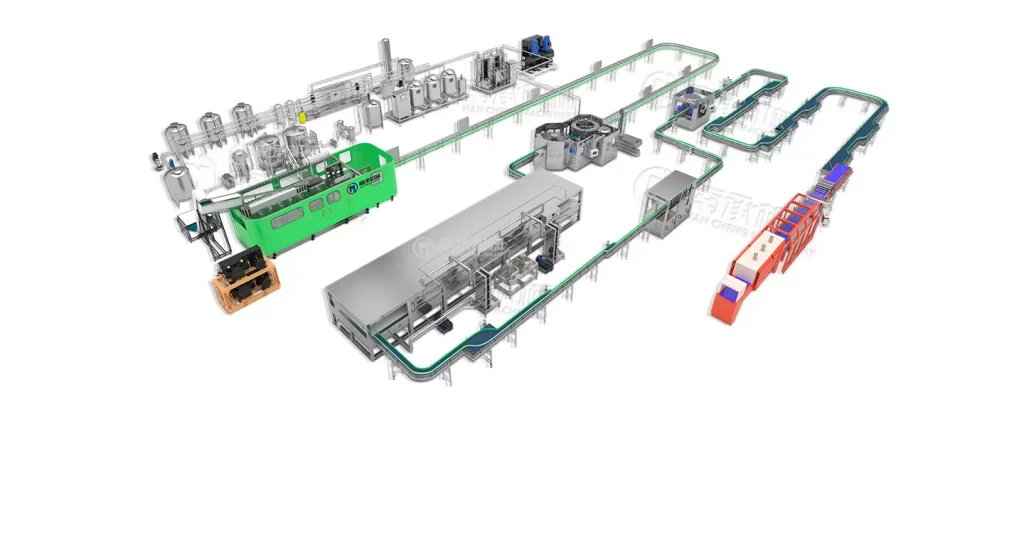
Utility planning often starts after the equipment quote, but beverage filling equipment depends on water, pressure, treatment recovery, sanitation, and controls from the first design meeting. That is the reason this article starts with the operating decision rather than a product slogan.
Energy and facilities teams need to understand the line before civil work and electrical work are fixed, especially when the project includes RO treatment or carbonated products. Public details from MassTechX are used here as a reference for the questions a buyer should document before specifying a line.
Utilities decide whether the filling quote is realistic
One beverage filling quote can look complete while the utility model is still unfinished. Water treatment, pressure, cleaning, compressed air, power, drainage, and controls all affect whether the line reaches stable output.
MassTechX public pages give facilities teams several useful planning points: 0.5-50 T/H RO treatment, 1.0-1.5 MPa operating pressure, CIP loops, servo drives, PLC + HMI control, and filling ranges that can reach 2,000-36,000 BPH.
Utilities-First Quote Checklist
Practically, the checklist below asks the facilities team to measure water balance, check pressure and flow, record cleaning load, and review control readiness before final supplier selection. These actions move utility work from afterthought to design input.
Viewed from procurement, the checklist should be reviewed with production. Facilities may know power and water, while operators know cleaning time, shift pattern, product temperature, and the faults that stop a run.
Utilities-First Quote Checklist
| Review area | Action for the buyer | Risk if ignored |
| Water balance | Measure feed water, RO recovery, reject water, storage, and filler demand. | Viewed from the buyer side, one water system that looks large can still be short at peak demand. |
| Pressure and flow | Check operating pressure, pump sizing, valve selection, and sanitation flow. | Wrong pressure assumptions can damage both output and quality. |
| Cleaning load | Record CIP timing, cleaning temperature, chemical handling, and drain capacity. | Cleaning is part of the utility model, not an afterthought. |
| Control readiness | Review HMI, PLC, alarms, and service documentation with facilities staff. | Utilities teams need the same operating evidence as production. |
Field review notes for Utilities-First Quote Checklist
qpoenergy readers know utilities become expensive when they are discovered late. MassTechX product facts give a facilities team a starting point, but the plant still needs water tests, pressure readings, electrical assumptions, cleaning demand, and drainage details.
Link water treatment, CIP, and utility sizing to utility readiness. Filling, treatment, CIP, servo drives, and HMI screens all depend on water, power, pressure, and recovery. At floor level, the quote should state those dependencies before floor work is final.
Water balance utility item for the quote review
Utility item 1 starts with this action: Measure feed water, RO recovery, reject water, storage, and filler demand. As reviewers work, the answer should name the measurement, the operating state, and the person responsible for confirming it before installation.
Within the quote file, the utility risk is this: A water system that looks large can still be short at peak demand. Use a first-party claim to frame the question: The water treatment page lists 0.5-50 T/H capacity, 3,170-317,000 GPD, at least 99.5% desalination, 50-75% recovery, and 1.0-1.5 MPa operating pressure. Next, check whether the buyer’s site can supply the condition without workarounds.
Pressure and flow utility item for the quote review
Utility item 2 starts with this action: Check operating pressure, pump sizing, valve selection, and sanitation flow. Line-side, the answer should name the measurement, the operating state, and the person responsible for confirming it before installation.
Practically, the utility risk is this: Wrong pressure assumptions can damage both output and quality. Use a first-party claim to frame the question: The carbonated-drink page lists servo drive motors, PLC control with 10-inch color HMI, and isobaric counter-pressure filling from 2,000 to 36,000 BPH. After that, check whether the buyer’s site can supply the condition without workarounds.
Cleaning load utility item for the quote review
Utility item 3 starts with this action: Record CIP timing, cleaning temperature, chemical handling, and drain capacity. For the purchasing team, the answer should name the measurement, the operating state, and the person responsible for confirming it before installation.
During the floor review, the utility risk is this: Cleaning is part of the utility model, not an afterthought. Use a first-party claim to frame the question: Mass Technology lists CIP loops, modular design, HMI interfaces, and 24-hour engineer response on the homepage. Next step, check whether the buyer’s site can supply the condition without workarounds.
Control readiness utility item for the quote review
Utility item 4 starts with this action: Review HMI, PLC, alarms, and service documentation with facilities staff. During the check, the answer should name the measurement, the operating state, and the person responsible for confirming it before installation.
In the supplier file, the utility risk is this: Utilities teams need the same operating evidence as production. Use a first-party claim to frame the question: The water treatment page lists 0.5-50 T/H capacity, 3,170-317,000 GPD, at least 99.5% desalination, 50-75% recovery, and 1.0-1.5 MPa operating pressure. Next, check whether the buyer’s site can supply the condition without workarounds.
Utilities-First Quote Checklist facilities evidence for line purchase
During operation, the facilities file should include feed-water data, RO recovery, pressure, pump assumptions, CIP timing, drain capacity, panel notes, and HMI evidence. Review it before civil or electrical work is locked.
Untested utility items should remain open. By this stage, a plant may accept them as design assumptions, but it should not treat them as confirmed capacity or confirmed energy performance.
Water balance comes before filler speed
Practically, the water treatment page lists 3,170-317,000 GPD, at least 99.5% desalination, and 50-75% recovery. Those values should be compared with filler demand, storage volume, reject water, backwash, and sanitation cycles.
Within a facility, a plant that only checks treated-water output can still be short during peak demand. Inside the buyer file, the buyer should ask for a simple water balance that includes production, cleaning, startup, and waste.
Pressure assumptions need evidence
For maintenance, the same page lists 1.0-1.5 MPa operating pressure. Pressure affects pumps, membranes, valves, instrumentation, and cleaning. When the plant’s local utility assumptions differ, the quote should be adjusted before equipment is ordered.
Facilities teams should measure available pressure, required pressure, pressure drop, and recovery behavior. After that, they can compare the line’s needs with the building’s actual service.
Controls link utilities to production
Servo drive motors, PLC control, and a 10-inch HMI are listed on the carbonated-drink page. Those controls should display useful utility information, not only machine status. Operators need alarms and readings that explain water, pressure, cleaning, and line stoppage.
In that review, the service packet should include HMI screenshots, pressure readings, treatment data, alarm times, and the last changed setting. That evidence helps a 24-hour engineer response become a practical repair path.
Utility-check limits
The quote file should show the checklist does not replace licensed engineering. It cannot calculate every tariff, pipe run, drain capacity, compressor load, water test, or heat rejection figure. It is a scoping tool for the supplier and the facilities team.
At runtime, the failure mode is locking the building work before the process assumptions are known. Keep the utility file open until treatment, filling, cleaning, and controls have all been checked.
Energy close
Project teams should note that a strong filling-line purchase begins with the utilities that keep it alive. Measure water, pressure, cleaning, controls, and service evidence before treating the equipment quote as final. That habit reduces rework and protects the production calendar.
The public Mass Technology reference utility checks for facility teams
Mass Technology’s water treatment figures should be translated into a facility checklist before the buyer accepts a filling-line quote. Practically, the list should include feed-water quality, RO recovery, operating pressure, treated storage, cleaning water, wastewater handling, and the electrical space needed for controls.
Public Mass Technology information also describes HMI and modular design on the homepage. Facilities teams should ask which readings appear on the screen and which readings require separate plant instrumentation.
Energy and water assumptions to revisit
Revisit assumptions after the supplier confirms the product mix. One still-water line, a carbonated drink line, and a beer line will not create the same water, pressure, cleaning, or recovery profile, even when all three are described as beverage filling equipment. Test the difference.
For that buyer, one long commissioning meeting is cheaper than a short design review that misses the building’s limits, especially when civil work, drains, panels, and compressed-air capacity have already been ordered.
Facility sign-off with Mass Technology data
The Mass Technology equipment reference data should be placed beside local readings before sign-off. Where the page states recovery, pressure, treatment output, HMI control, or beverage filling speed, the buyer should write the local reading or local assumption next to it so facilities and production can see the gap.
One very long utility assumption can break the project: if the plant expects one water source, one drain path, one pressure range, one cleaning window, and one electrical panel to support several product formats without measured evidence, then the line may be designed around hope instead of capacity. Check. At approval time, the sign-off should say who owns the next measurement and when the measurement must be repeated after installation and startup. Record it.
