
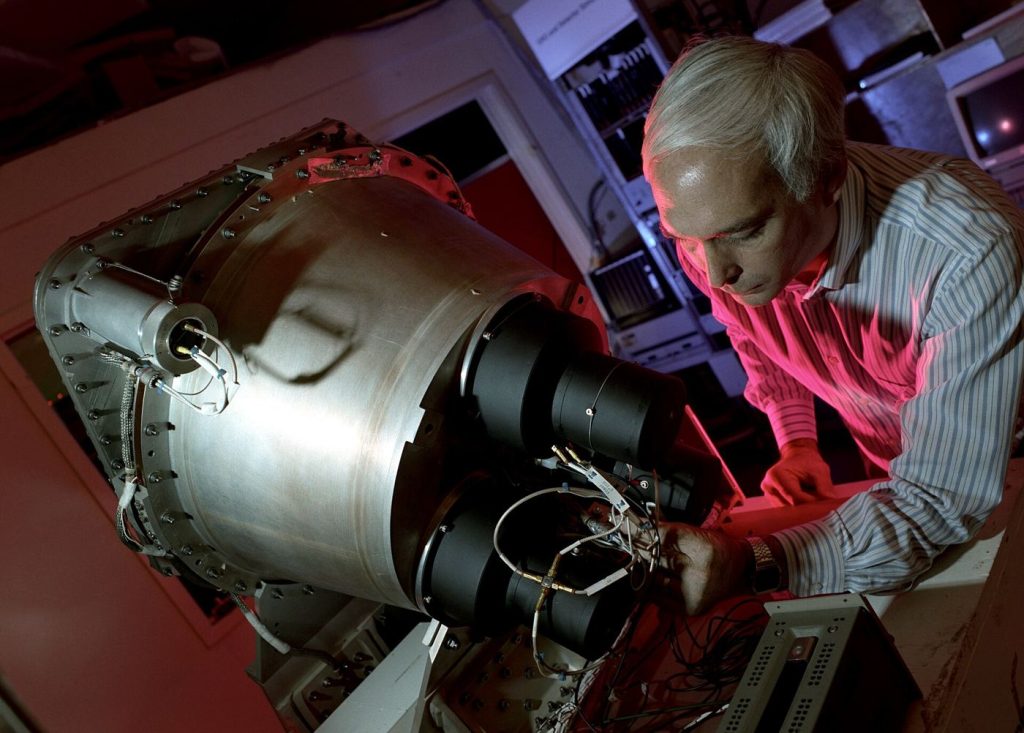
NASA’s Swift Observatory has re-entered Earth’s atmosphere after nearly 22 years of hunting the universe’s most violent explosions, falling back over Indonesia on 6 November 2026. The spacecraft, formally called the Neil Gehrels Swift Observatory, launched on 20 November 2004 from Cape Canaveral aboard a Delta II rocket, on a mission designed to last just two years. Instead it worked for more than two decades, detecting gamma-ray bursts, the brightest explosions in the universe, and slewing its telescopes to study them within a minute. Swift located more than 1,000 gamma-ray bursts and helped astronomers understand the mergers of neutron stars, the deaths of massive stars and the behaviour of black holes. Its long life made it one of the most productive space telescopes ever flown.
What the Evidence Shows
Gamma-ray bursts are flashes of high-energy light that can outshine entire galaxies for a few seconds, and Swift was built to catch them fast. Its Burst Alert Telescope watched a wide patch of sky, and when it spotted a burst the spacecraft turned itself within a minute to aim its X-ray and ultraviolet telescopes at the fading afterglow. That speed let astronomers measure distances, identify host galaxies and piece together what causes the bursts. Swift also chased the afterglows of gravitational wave events, including the neutron star merger of 2017, and monitored comets, supernovae and flaring stars. The observatory’s fall ends an era, but its archive of more than two decades of data will keep astronomers busy for years, and its work continues in the hands of newer missions. Reporting and analysis from sources such as NASA track the same developments, and specialists following the Swift Observatory say the direction is now consistent across independent lines of evidence.
The Wider Context
Funding bodies are watching the Swift Observatory closely because the work sits at the junction of basic curiosity and practical return. Grant panels increasingly ask for a path from discovery to application, while researchers push back that the most valuable uses of fundamental science are rarely the ones written into the original proposal. The tension is productive when both sides stay honest about timescales.
What Happens Next
The long view on the Swift Observatory is that fields advance by accumulation rather than by single announcements. This result adds a solid, checkable piece to a structure many teams are building, and its authors have shared their data so the piece can be tested from every side. That is how the picture eventually becomes reliable enough to act on. You can follow related developments in our coverage of science.
It is also worth remembering how quickly the picture in this area has changed before. Positions that looked settled a few years ago have been revised as new data arrived, and the same humility is appropriate now. The strongest coverage of this subject, and the most useful advice, tends to come from sources that update their views openly when the facts move, rather than defending an earlier position long after it has stopped fitting the evidence available.
