
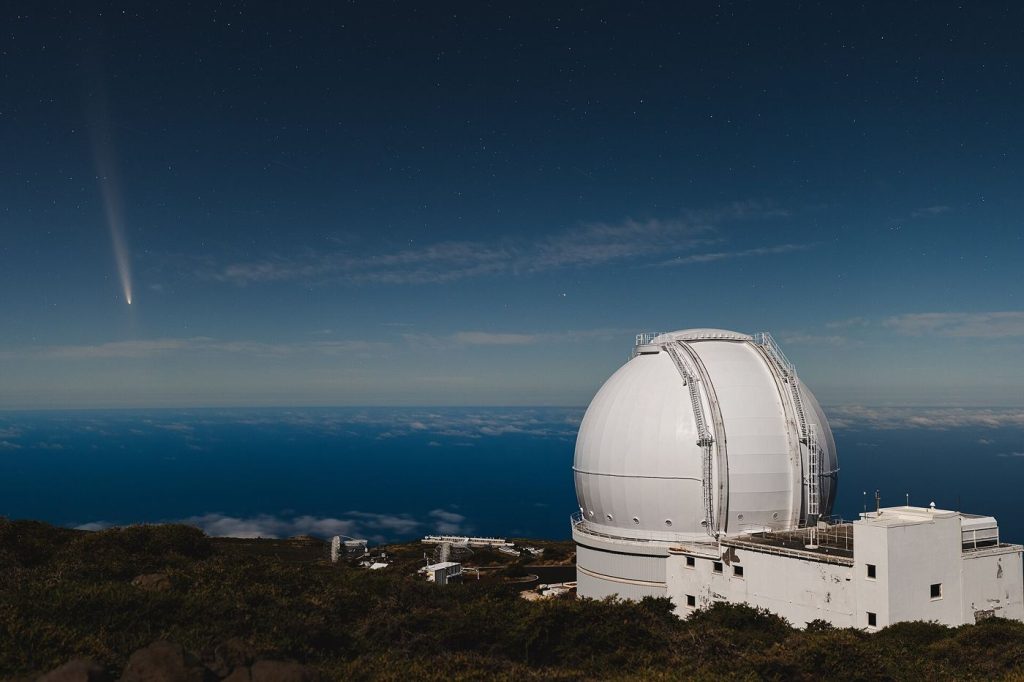
NASA released a new set of images of interstellar comet 3I/ATLAS on 19 November 2026, showing the third known visitor from another star system as it leaves our Solar System. Three NASA Mars spacecraft had front-row seats in early October as the comet passed Mars: the Mars Reconnaissance Orbiter captured its coma from 19 million miles away, the MAVEN orbiter imaged it in ultraviolet, and the Perseverance rover caught a faint glimpse with its Mastcam-Z camera on 4 October. The comet will make its closest approach to Earth on 19 December, staying about ten times farther away than it got to Mars. The comet’s closest approach to the Sun was around 30 October, when it passed inside the orbit of Mars at about 210 million kilometres from the star.
What the Evidence Shows
The comet was discovered on 1 July 2025 by an ATLAS telescope in Rio Hurtado, Chile, and travels at about 60 kilometres per second on a hyperbolic path that will never return. Webb observations in June 2026 detected methane on the comet for the first time on an interstellar visitor, and later data showed its deuterium ratio was 13 times higher than comet 67P, suggesting it formed more than seven billion years ago, before the Sun was born. Scientists say it poses no threat to Earth and will never come closer than 240 million kilometres, but it offers a rare sample of another star system’s building blocks. Webb also found chemical similarities between 3I/ATLAS and icy objects beyond Neptune, suggesting shared origins in cold, distant regions of other star systems. Reporting and analysis from sources such as NASA track the same developments, and specialists following interstellar comet 3I/ATLAS say the direction is now consistent across independent lines of evidence.
The Wider Context
Funding bodies are watching interstellar comet 3I/ATLAS closely because the work sits at the junction of basic curiosity and practical return. Grant panels increasingly ask for a path from discovery to application, while researchers push back that the most valuable uses of fundamental science are rarely the ones written into the original proposal. The tension is productive when both sides stay honest about timescales.
What Happens Next
The long view on interstellar comet 3I/ATLAS is that fields advance by accumulation rather than by single announcements. This result adds a solid, checkable piece to a structure many teams are building, and its authors have shared their data so the piece can be tested from every side. That is how the picture eventually becomes reliable enough to act on. You can follow related developments in our coverage of science.
It is also worth remembering how quickly the picture in this area has changed before. Positions that looked settled a few years ago have been revised as new data arrived, and the same humility is appropriate now. The strongest coverage of this subject, and the most useful advice, tends to come from sources that update their views openly when the facts move, rather than defending an earlier position long after it has stopped fitting the evidence available.
