
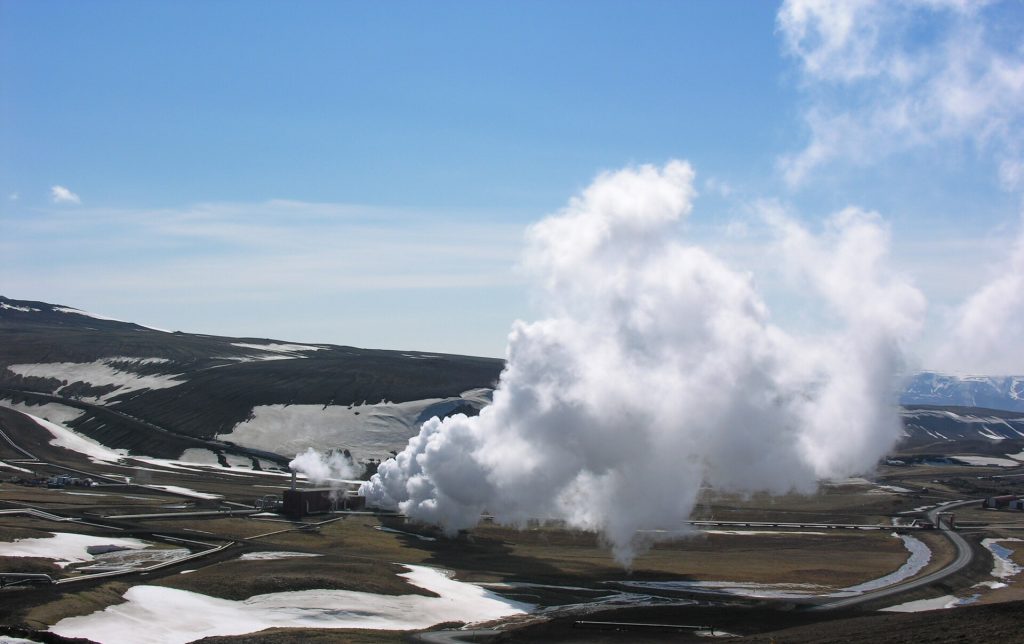
Geothermal energy has always had an enviable pitch: clean power, available day and night, from heat that never stops rising from the Earth’s interior. Its problem was geography. Conventional plants needed rare places where hot water, fractured rock and permeability coincided near the surface — Iceland, Kenya’s Rift Valley, parts of California. Enhanced geothermal systems aim to remove that lottery by engineering the reservoir wherever the rock is hot enough.
The revival now under way borrows shamelessly from the shale revolution. Horizontal drilling, multi-stage fracturing and fibre-optic sensing, refined over two decades by oil and gas engineers, are being applied to hot, hard basement rock that conventional geothermal tools could barely scratch. The result, as followers of our energy coverage will have noticed, is a wave of pilot plants reporting results that would have seemed fanciful ten years ago.
How Enhanced Geothermal Works
The recipe sounds simple and is anything but. Drill two wells several kilometres down into rock hotter than 200 degrees Celsius, fracture the rock between them to create an artificial reservoir, then circulate water down one well and up the other, harvesting heat to drive a turbine. No natural hot spring required — only depth, temperature and fractures that stay open under immense pressure.
Recent demonstrations in Utah and Nevada have shown wells flowing at commercially interesting rates, with drilling times falling sharply as crews adapt shale techniques to far harder, hotter rock. Drill bits, muds and electronics rated for extreme temperatures are the industry within the industry: a sensor that survives 300 degrees is a product in itself.
Why the Timing Has Changed
Three forces converged. First, the shale workforce — drillers, geologists and completion engineers — became available and interested as oil and gas growth slowed. Second, buyers appeared: technology companies hunting firm, carbon-free power for data centres have signed agreements for geothermal electricity at prices renewables-plus-storage struggle to match for round-the-clock supply. Third, governments streamlined permitting for geothermal on public land and funded demonstration wells, with research coordinated through agencies such as the US Department of Energy at energy.gov.
The International Energy Agency’s recent geothermal assessment, available via iea.org, argues the resource accessible with next-generation techniques is vast — enough, in principle, to meet global electricity demand many times over — and that costs should fall with drilling experience as they did for shale.
The Honest Obstacles
Sceptics raise fair points. Every reservoir is an experiment: fracture networks can short-circuit, sending water back too quickly to heat up, and induced seismicity, though usually tiny, ended projects in Switzerland and South Korea after felt earthquakes. Water use, mineral scaling inside pipes and the sheer capital risk of a first well at a new site all argue for caution.
Costs remain the central question. Early enhanced plants generate power well above solar-plus-battery prices; the industry’s bet is a steep learning curve as drilling standardises. Investors are effectively wagering that geothermal follows shale’s trajectory from expensive novelty to routine engineering.
Superhot and the Longer Game
Beyond today’s projects lies a more radical target: superhot rock, above 400 degrees, where water becomes supercritical and each well could yield five to ten times the power. Icelandic and Italian experiments have drilled into such zones, sometimes accidentally meeting magma. If the materials challenges — casings and cements that survive — can be solved, the geography of geothermal widens to almost anywhere willing to drill deep enough.
The Bottom Line
Enhanced geothermal will not displace wind and solar, nor does it need to. Its prize is the one thing those sources cannot offer alone: clean, constant power in almost any region. Paired with the flexible grid described in our report on record battery storage deployments, it completes a plausible picture of a system that runs on weather when weather cooperates, on stored energy in the gaps, and on the Earth’s own heat underneath it all.
